Complete Guide to Drinking Water Filling Machine Selection: Key Parameters from Capacity to Precision
With bottled water consumption continuing to rise globally, the drinking water filling machine has become the core equipment of any production line. Its selection directly impacts product quality, production efficiency, and return on investment. According to industry data, the global liquid filling equipment market reached approximately US$2.4 billion in 2025 and is projected to grow to US$3.2 billion by 2032, with bottled water filling machines accounting for a significant portion of this demand.
This article provides a systematic overview of drinking water filling machines, covering product functions, core parameters, and selection criteria to help you make an informed purchasing decision.
1. What Is a Drinking Water Filling Machine?
A drinking water filling machine is an automated piece of equipment used for the production of bottled mineral water, purified water, spring water, and other non-carbonated beverages. Modern mainstream models typically adopt a three-in-one integrated design that combines rinsing, filling, and capping into a single unit, with the entire process running automatically.
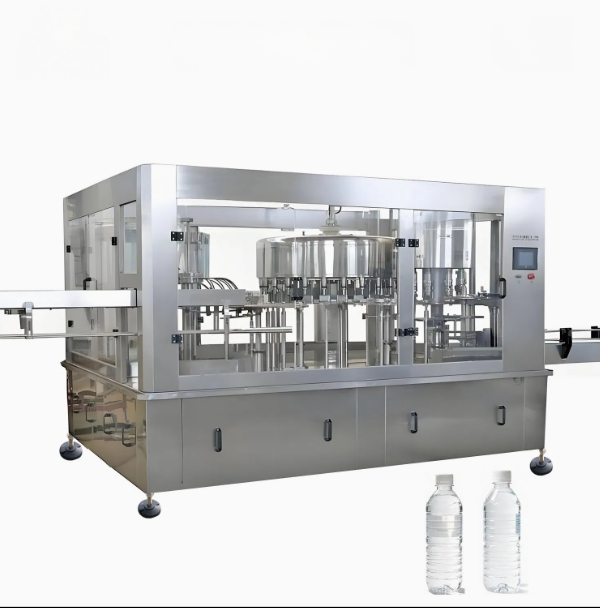
The machine body is constructed from SUS304 or SUS316 food-grade stainless steel, meeting drinking water hygiene standards and ensuring no secondary contamination occurs during production.
Core Operating Principle:
Empty bottles enter the machine via an air conveyor system or bottle conveyor. Using a neck-handling technology for positioning and transfer, bottles pass sequentially through:
Rinsing station: High-pressure water or disinfectant spray cleaning
Filling station: Gravity-fed or pressure-fed quantitative filling
Capping station: Magnetic torque capping
The entire process is controlled by a PLC system with a touchscreen interface, achieving filling accuracy of ±0.2% to ±1% and consistently high capping quality.
2. Key Product Advantages
2.1 Three-in-One Integration: Space and Cost Savings
By integrating washing, filling, and capping into a single unit, the machine significantly reduces floor space requirements compared to separate equipment. It also minimizes contamination risks during bottle transfer between individual machines. Some manufacturers now offer four-in-one designs (adding sterilization functions) for even higher line integration.
2.2 High-Precision Filling: Minimizing Product Loss
Using a liquid tank feeding system combined with high-flow filling valves and servo control technology, each bottle achieves a consistent fill level. Premium equipment can control filling accuracy within ±1%, protecting your brand reputation while reducing costly product giveaway.
2.3 Fully Automated Operation: Reducing Labor Dependence
From bottle feeding, rinsing, filling, and capping to output, the entire process runs automatically. Smart features such as no-bottle-no-fill and no-bottle-no-cap photoelectric detection systems ensure intelligent operation. For large-scale producers, fully automatic filling machines significantly reduce labor costs and human error.
2.4 Flexible Changeover: Adapting to Multiple Bottle Sizes
With neck-handling transmission technology, bottle size changeovers require no height adjustments—only the replacement of guide plates that contact the bottle body. Changeover time can be kept within 30 minutes. This flexibility allows businesses to efficiently switch between 330ml to 2000ml PET bottles of various specifications.
3. Main Machine Types and Specification Comparison
Drinking water filling machines are primarily divided into rotary and inline types:
| Machine Type | Capacity Range | Suitable Bottle Sizes | Key Features |
|---|---|---|---|
| Rotary Three-in-One | 3,000 – 24,000 BPH | 330ml – 2000ml PET | High output, ideal for large-scale continuous production |
| Inline Filling Machine | 300 – 800 BPH | 3L – 19L large bottles/barrels | Simple structure, suitable for small-medium scale, rapid multi-bottle changeover |
Common Model Specifications (Reference) :
| Model | Rinsing Heads | Filling Heads | Capping Heads | Capacity (500ml) |
|---|---|---|---|---|
| CGF 8-8-4 | 8 | 8 | 4 | 2,500 – 3,000 BPH |
| CGF 18-18-6 | 18 | 18 | 6 | 6,500 – 7,000 BPH |
| CGF 24-24-8 | 24 | 24 | 8 | 12,000 – 13,000 BPH |
| CGF 32-32-10 | 32 | 32 | 10 | 15,000 – 16,000 BPH |
| CGF 40-40-12 | 40 | 40 | 12 | 18,000 – 20,000 BPH |
4. Key Selection Criteria to Consider
4.1 Capacity Matching
Determine the required equipment capacity based on your expected daily output:
3,000 – 8,000 bottles/hour: Suitable for small to medium-sized water plants in start-up phase
10,000 – 20,000 bottles/hour: Suitable for growing enterprises
Recommendation: Allow for 20% surplus capacity to handle peak season demand
4.2 Filling Accuracy
Accuracy directly impacts product consistency and cost control:
Gravity filling: Achieves accuracy of ±0.2% with higher precision
Flow meter filling: Higher efficiency but requires stable product characteristics
For drinking water production, we recommend selecting machines with fill level accuracy within ±1%
4.3 Materials and Hygiene Standards
The entire machine should be constructed from SUS304 or higher-grade stainless steel
Parts that come into direct contact with the product should use SUS316L for enhanced corrosion resistance
Equipment should include a CIP (Clean-in-Place) system for easy cleaning
Ensure compliance with food hygiene certifications (FDA, CE, etc.)
4.4 Automation and Intelligent Control
Prioritize models equipped with brand-name PLC (Siemens, Mitsubishi, etc.) and large touchscreen displays
Look for features like data storage and production statistics reporting
Consider machines with remote monitoring and fault diagnosis capabilities to reduce maintenance costs
4.5 After-Sales Service and Spare Parts Availability
Evaluate the supplier's capabilities in:
Complete line delivery and integration support
Installation, commissioning, and operator training services
Industry-leading manufacturers typically offer 1-2 years warranty
Common spare parts delivered within 48 hours; on-site service within 48 hours (outside province)
5. Emerging Technologies Shaping the Future
5.1 Blow-Fill-Cap (BFC) Integration
Advanced blow-fill-cap integrated systems combine blow molding, filling, and capping in a single unit. Compared to traditional lines with separate machines, BFC technology can reduce packaging material consumption by up to 35%, energy use by 20%, water consumption by 35%, and floor space by 65%.
5.2 IoT and Smart Monitoring
Modern filling machines are equipped with IoT sensors and cloud platforms that enable real-time data collection on production output, energy consumption, and equipment status. Managers can remotely monitor production lines from anywhere in the world.
5.3 Predictive Maintenance
Machine learning algorithms analyze vibration, temperature, and current parameters to predict potential breakdowns before they occur, reducing unplanned downtime by 30-50%.
6. Conclusion
The drinking water filling machine is the heart of any bottled water production line. Selecting the right equipment requires careful consideration of capacity, accuracy, materials, automation level, and after-sales support. Whether you are a large-scale producer pursuing high-speed output or a small to medium-sized enterprise prioritizing flexible changeover, choosing equipment that matches your specific production needs is essential for achieving optimal production efficiency and return on investment.
Keywords : drinking water filling machine, bottled water production, water filling equipment, PET bottle filling line, three-in-one filling machine